Stage: Planning phase · Independent project
Sustainability
How the park could use less energy, less water and fewer new materials. Every idea here is still to be tested.
Current stage: Planning phase
- Planning phase (current stage)
- Design
- Building
- Open
Less wasteful: one of our four tests
Every idea on this site has to pass four tests; this page is about the third. Each idea is tagged with the smallest park size where it would first appear. Each larger size keeps what the smaller one has. A split tag, such as A/B, means it could start at either size, and “Every scale” marks basics every version needs.
Test 3, less wasteful: reuse before new
Reuse an existing or under-used site first. Plant natives instead of thirsty lawn, offer free water refill, use reusable dishware, and repair before replacing.
Energy: only natural sources, stored and shared
The cheapest energy is the energy a park never uses. We would start with efficient lighting, then aim to use only natural energy: solar and batteries first, and heat from the ground or reused heat where they fit.
Light that stays where it is needed
Efficient LED lights, fully shielded so they shine down on paths and stay out of the sky and neighbors’ windows. The light would be warm in color, and it would dim after an evening curfew. This follows guidance from DarkSky International, a group that works to protect the night sky.
Solar on carports or roofs
Solar panels could sit on canopies over parking or on building roofs. We would keep arrays under 1 megawatt (MW), a measure of how much power they make at their peak. The Scale B drawing below shows possible solar canopies over part of the parking.
Batteries for the busiest hours
Batteries connected to the grid could store power and use it during the busiest hours, so the park draws less from the grid at its peak. Batteries can also keep some power on during an outage. Thermal storage, heat or cold kept in water tanks, could help a building that needs it.
Heat from the ground, and heat used twice
Ground-source (geothermal) heat pumps could heat and cool the buildings using the steady temperature underground. Heat recovery would reuse warmth that machines already make, for example from the food hub’s fridges and freezers, to warm water. Each would be used only where a site study shows it fits.
Our aim: only natural energy
- Solar
- Wind
- Hydro, only where permitted, with fish passage and the required reviews
- Geothermal, heat from the ground
- Heat recovery, reusing heat that machines already make
Energy would be stored in batteries, in thermal storage, or in pumped storage where the land allows.
On the park itself: efficient lighting, solar, batteries, and ground-source heat or heat recovery where they fit. Wind turbines, hydro and pumped storage belong at regional sites, not in the park, and any stream on the site stays protected.
More natural power could come through the Energy & Logistics Hubs, a separate planned project that repeats region by region. Power crosses the grid only under the electric utility’s and the state’s rules. These are aims; whether they fit a real site is unknown.
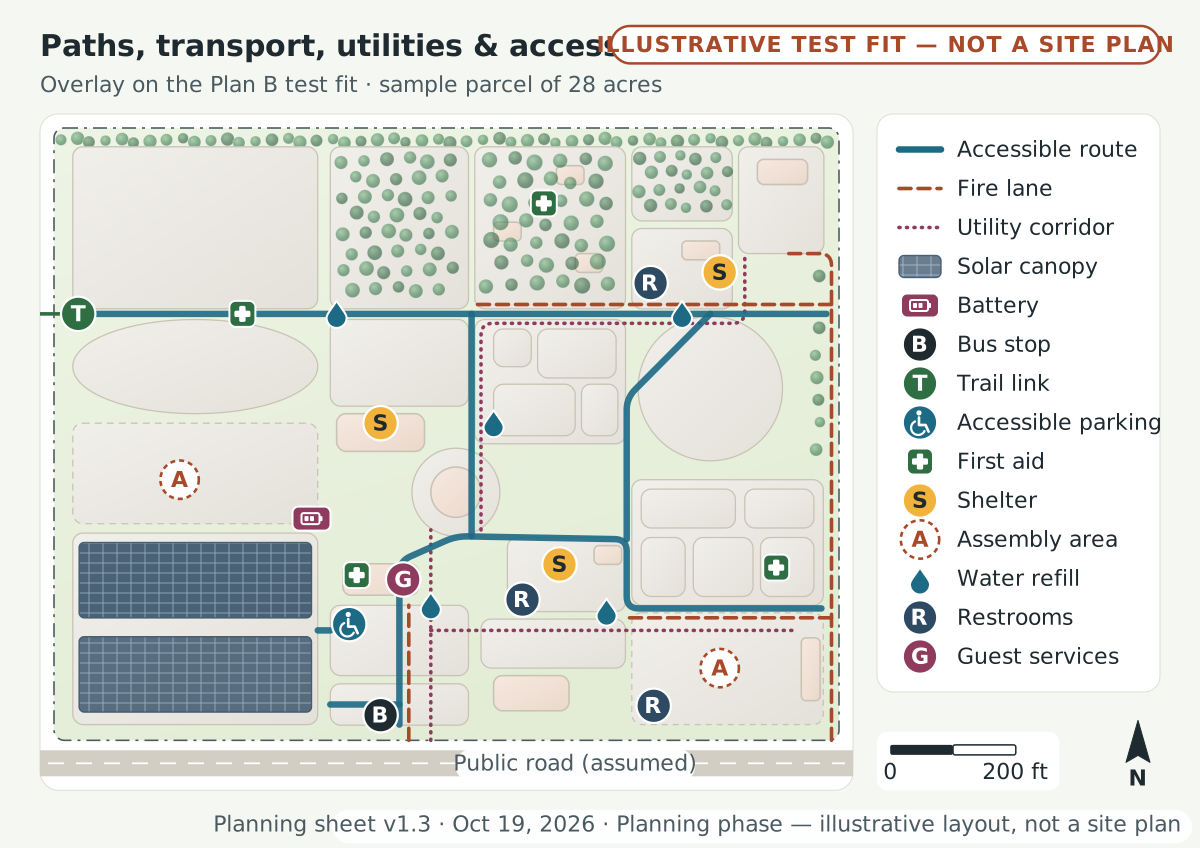 (opens the full-size drawing in a new tab)
Key, legend and notes
Plan B test fit on a sample parcel, 1,250 × 975 ft (assumed) = 28.0 acres
Legend
- Accessible route
- Accessible route: firm, stable, slip-resistant; running slope 5% or less where feasible, cross slope 2% or less (ADA 2010 §402–403)
- Fire lane
- Emergency and fire-apparatus access: 20 ft minimum width, 13 ft 6 in clearance (IFC §503, if adopted locally)
- Utility corridor
- Shared utility corridor: water, sewer, electric, data (routes to be set by engineers and utilities)
- Solar canopy
- Solar carport canopy (possible; needs utility interconnection review)
- Battery
- Battery storage and switchgear (possible)
- Bus stop
- Bus or shuttle stop and ride-share drop-off at the entry (a Bethlehem Connect stop only if that separate project ever serves the site)
- Trail link
- Trail connection (if a regional trail is nearby)
- Accessible parking
- Accessible parking and drop-off closest to the entry
- First aid
- First aid and AED (defibrillator) stations
- Shelter
- Severe-weather and lightning shelter buildings
- Assembly area
- Evacuation assembly areas
- Water refill
- Free drinking water and bottle refill
- Restrooms
- Restroom buildings: all-gender family rooms, refill (the Welcome Hub also has restrooms)
- Guest services
- Guest services and security: staffed whenever open; lost-child meeting point (planning assumption)
- Overlay on the Plan B test fit: how people, emergency vehicles, water, power and data would move.
- Every attraction, restroom and food area on an accessible route; companion seating and quiet areas spread through the park.
- Fire lanes double as promenades. Rides and stages reachable by ambulance.
- Utility routes, capacities and connection fees are unknown until a site is confirmed and utilities are consulted.
- Independent community project, planning phase: nothing is funded or built yet. Not an official municipal project. Dimensions are planning assumptions only; no engineering has been performed.
Solar would need the utility’s review
Solar can help with power bills. Any solar canopy would need the electric utility’s review before it could connect to the grid. Depending on the site, that is PPL or Met-Ed (now part of FirstEnergy Pennsylvania). On PPL, an array under 1 MW would usually be a Level 2 connection, with a $250 application fee plus $1 per kW. Study and upgrade costs are not published. We have not contacted either utility.
Incentives, as reported in October 2026
Tax credits and net metering could lower costs. Net metering means the utility credits a site for extra solar power it sends to the grid. Here is what we found, and what it would mean for this project.
How sure we are:Reported from news or secondary sourcesFact-checked confirmed or corrected by a second, independent searchUnknown not established yet
The ideas in the cards on this page are our own aims for this project.
Federal solar tax credit
Reported- What was reported
- Solar must be in service by Dec 31, 2027 (July 2025 law). The other path, starting construction by July 4, 2026, has passed.
- For this project
- On our illustrative timeline, a small pilot is about two years away at the earliest, after that deadline, so we do not count on it.
Elective pay (direct pay)
Reported- What was reported
- Nonprofits and governments can still get the credit as a direct payment.
- For this project
- We have not formed a nonprofit. A future nonprofit or a public landowner could qualify if the timing ever works.
Battery storage credit
Reported- What was reported
- Continues for projects that start construction through 2033, then phases down.
- For this project
- More time than the solar credit, if a later phase adds batteries.
Pennsylvania net metering
Fact-checked- What was reported
- Non-residential systems up to 3 MW qualify. Extra power each month is credited at the retail rate. Credit left at year end gets the “price to compare,” the utility’s standard supply price. PPL’s own pages confirm this for its area, and a system may not be sized above 110% of the account’s yearly use.
- For this project
- Under 1 MW sits well inside the 3 MW limit. It also avoids a new penalty on direct pay tied to domestic content (how much of the equipment is made in the U.S.). Met-Ed’s terms were not researched.
Connecting solar to the grid
Fact-checked- What was reported
- The utility is PPL or Met-Ed (now part of FirstEnergy Pennsylvania), depending on the site. On PPL, an array over 10 kW and up to 2,000 kW is a Level 2 connection: a $250 application fee plus $1 per kW. For example, 200 kW would cost $450 to apply. Met-Ed lists a $100 fee for the smallest systems; its other steps were not researched.
- For this project
- A park array under 1 MW would usually be Level 2 on PPL. Study and upgrade costs are not published, so they stay unknown. There is no confirmed site or design, and we have not contacted either utility.
Sources, read as search extracts on October 18, 2026: Kirkland & Ellis summary of the 2025 clean-energy credit changes (opens in a new tab), Arnold & Porter summary of the 2025 clean-energy credit changes (opens in a new tab), IRS guide to elective pay (PDF) (opens in a new tab), Solar United Neighbors guide to net metering in Pennsylvania (opens in a new tab), PPL net metering page (opens in a new tab), PPL solar connection process and fees (opens in a new tab), Pennsylvania rule on connection fees (52 Pa. Code §69.2104) (opens in a new tab), FirstEnergy Pennsylvania connection page (opens in a new tab).
Possible help only
We treat these credits as possible help. The park’s plans never depend on them. The federal rules changed in July 2025, and they could change again. Every rule here would need checking against the official text before any decision. This page reflects what we found on October 18, 2026. We plan to update it as we learn more.
Water: plant for our climate, catch the rain, refill for free
Native plants need less watering, rain gardens keep rain on the site, and free refill stations replace bottled water.
Native plants, less lawn
Plants that grow naturally in this region and handle dry spells need less watering. Native meadows and gardens would take the place of thirsty lawn. Only lawns people use, such as the Great Lawn for music, films and seasonal events, would be watered. Plant choices would draw on DCNR’s Landscaping with Native Plants, Penn State Sea Grant’s Choose Native (2024) and Penn State Extension’s native meadow guidance.
Rain gardens and a wetland
Rain gardens are planted low spots that let rain from roofs and paths soak slowly into the ground. The Scale A test fit shows a rain garden and stormwater basin. A stormwater wetland is a pond with a boardwalk that holds rain running off hard surfaces, as the Scale B test fit shows. Both would follow the Stormwater Best Management Practices Manual from the Pennsylvania Department of Environmental Protection (PA DEP).
Free water refill
Free drinking water and bottle refill stations at every restroom and plaza, in place of bottled water.
Splash pad, an open choice
Optional and seasonal. It could be flow-through (fresh water used once) or recirculating (filtered and reused; the CDC’s Model Aquatic Health Code recommends a second disinfection step, such as UV light). Either way it needs a Pennsylvania Department of Health public bathing place permit (opens in a new tab). Test-fit size, not a design: about 2,500–5,000 sq ft plus an equipment room of about 200–400 sq ft.
City water and sewer
City water comes from the Wild Creek and Penn Forest reservoirs in Carbon and Monroe counties, about 10 billion gallons together (Bethlehem Authority history (opens in a new tab)). The City of Bethlehem’s wastewater plant is permitted for 20 million gallons a day, but since 2012 it has been held to 15.5 million because of the amount of waste in the water; a 2023 city study looked at raising that (the city’s 2023 sewer study, PDF (opens in a new tab)). Any site on city sewer would need a capacity check before restrooms, a food pavilion or a splash pad are designed.
Room for rain and floods
In the test fits, paths, buffers and stormwater margins take about 34% of the Scale A parcel and 29% of Scale B. On any site, rides and buildings would stay out of floodways. Land that floods now and then would hold only meadows and trails.
Waste: reuse first
The easiest waste to handle is the waste that never happens. Reuse comes first, then recycling.
Reusable dishes and deposit cups
The food pavilion would serve food on reusable dishes. Drinks would come in deposit cups: a visitor pays a deposit and gets it back when they return the cup.
Recycle, compost, no single-use plastic
Sorting points for recycling, compost and trash would stand at every entrance, at the Welcome Hub and at every event. Food and garden waste would be composted for the gardens, on site or with a local partner, and the park would not sell single-use plastic. No compost partner has been found yet.
Salvage and reuse when building
Building would start from what is already there: paths, trees, soil and sound structures stay where they work. Materials taken out would be salvaged and reused, and new ones would be natural, local or reused wherever practical.
Borrow what you need
An equipment library would lend wagons, strollers, sun hats and sensory kits during a visit, so families would not need to bring their own.
A small shop with lasting goods
A small, affordable shop selling durable, local items with a low markup.
Kindness first, honest about costs
Donated plants, materials and equipment can go a long way, and so can volunteers in roles they choose, such as garden helper or cleanup crew.
Free is the goal, including rides. Grounds, playgrounds, gardens, paths, drinking water and restrooms would be free every day, paid for by park income and committed public support. Rides would be free whenever someone reliably gives or pays for them. Otherwise they would stay as low as possible: about $2–$4 a ride, the range other public carousels charge, with free-ride days. Something is only free when someone reliably gives it or pays for it, so we would name who before promising it, and keep a backup for anything critical. Some costs remain whatever happens: ride insurance, state registration and inspections every 30 days, parts and maintenance, water, sewer and electricity, and trained ride operators aged 16 or older. Safety never waits on a gift.
Materials and land: built to last, reuse before new
Things that last and can be fixed waste less and cost less over time. The same goes for land: using a place that already exists comes before taking new land.
Built to last, priced over its whole life
Durable, repairable materials, sourced locally where we can. We would repair before replacing. Before buying anything, we would add up its full cost over its life: the price to buy it, plus the energy, water, repairs and replacement it will need.
Rides and play that are easy to look after
Easy-care play equipment from Scale A. A few low-maintenance rides, chosen for reliability, only from Scale B, after a small pilot meets its targets.
Reuse a site before new land
We would look first at existing or under-used places. Our research suggests exploring small pilot pieces in existing city parks. The main location is being finalized, and no landowner has confirmed a site in writing.
Share parking before paving more
Every 100 parking spaces takes about three-quarters of an acre (a planning assumption). Shared parking, buses and trails would shrink that. The Scale B test fit puts about 190 of its spaces on grass pavers, a grid that lets grass grow through, for overflow days.
Reusing old industrial land has a catch
Former Bethlehem Steel land has recorded cleanup limits that allow only nonresidential use. Pennsylvania’s Land Recycling Program notes that a playground likely needs a stricter cleanup standard, because children play in and touch the soil. Reuse is still our first choice, as long as it is safe for children. PA DEP Land Recycling Program (opens in a new tab)
Fitting Bethlehem’s climate goals
The City of Bethlehem released its Climate Action Plan on April 12, 2021. It sets targets for cutting greenhouse gas emissions across the whole community, measured against 2017. A 2026 progress update has also been published.
2025
33% below 2017
2030
60% below 2017
2040
Net-zero
Fact-checkedNet-zero means cutting emissions as far as possible and balancing out the rest. Source: City of Bethlehem Climate Action Plan release presentation (2021, PDF) (opens in a new tab).
Our own aims for a park on city land
We would aim for a park that is all-electric (heating and cooking by electricity, no gas on site), solar-ready (roofs, wiring and parking planned so panels can be added later, even without money at first) and low-water (the water ideas above). These are our aims, not the city’s. Nothing has been agreed in writing with the City.
Honest limits
Here is what we know and what we still have to find out.
Nothing here is engineered
There has been no engineering, surveying, environmental testing or cost estimate. Stormwater and splash pad permits have not been requested. Any real design would need local engineers, environmental review, community input and written permission from a landowner.
Known, with sources
- Federal solar credit: in service by Dec 31, 2027. Reported
- Pennsylvania net metering: up to 3 MW, confirmed on PPL’s pages. Fact-checked
- PPL solar connection, Level 2: $250 plus $1 per kW to apply. Fact-checked
- Splash pads need a state health permit, $10 per unit. Fact-checked
- City sewer plant: held to 15.5 of 20 million gallons a day. Fact-checked
- City climate goal: net-zero by 2040. Fact-checked
Unknown, still to check
- Which electric utility serves a real site, PPL or Met-Ed, and the study and upgrade costs to connect solar there.
- Met-Ed (FirstEnergy Pennsylvania) steps and fees, if a site is in its area.
- Water, sewer and electric capacity at any real site.
- Which local partner, if any, could take compost.
- Whether a splash pad would be flow-through or recirculating, and the local plan-review steps.
- Stormwater permit thresholds with PA DEP and the county conservation district.
- What any of this would cost. That needs professional estimates.
Help shape it
Do you know about native plants, composting, solar or saving water? Tell us what would help the park waste less, and what we have missed.
Share an idea